
Graffiti Girl
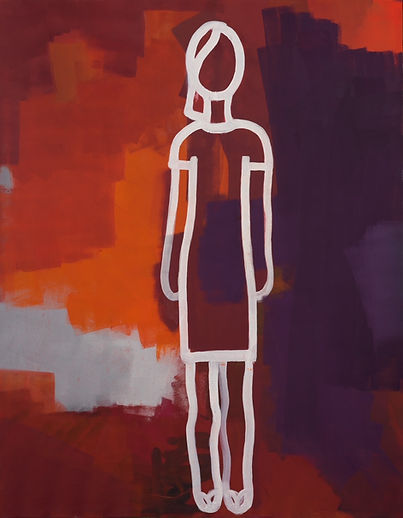
Graffiti Girl began with a conversation between Shakine and his daughters about what it means to have a roof over your head. From that conversation came the spare one-line figures of his daughters which Shakine began painting on walls that were themselves providing shelter for homeless people. The image began in the meeting between the security of home and family and the exposed life of the street.
And that dialogue became the starting point for a much longer journey. The girl left the wall and entered the studio, moving from graffiti to canvas. Something temporary, exposed to weather, time and whatever might happen in the street, became an object that could be kept and protected. The same figure remained, but its surroundings, and with them its meaning, had changed.
Eventually she left the studio again. This time, she returned to public space as sculpture. The figure that had first appeared as a fragile drawing on a wall now had a body, weight and a physical presence of its own. She was back outside, but no longer temporary.
Through these movements, from street to studio and back to the street, from wall to canvas to sculpture, the question that began with Shakine’s daughters keeps changing with the work. What makes somewhere a home? What does it mean to belong somewhere, to occupy a space, to be protected by it or exposed within it? Graffiti Girl never really settles the question. Like the figure herself, it keeps moving.

Selected works

Shades of blue, 2026
Oil on canvas 140x120cm

Tolstoy by the beach, 2026
Oil on canvas, 100x200cm

All together now, 2026
Oil on canvas, 110x100cm

Graffiti Girl (concrete),2022
Oil on canvas, 195x115cm
Jaffa Beach

Jaffa beach, 2026
Oil on canvas, 180x125cm
Jaffa Beach grows out of Graffiti Girl, but the solitary figure is no longer alone. Another figure has joined her, and the two ride together on a single bicycle. Seen directly from the front, we barely see the bicycle itself, mostly the handlebar held between them and a glimpse of the front wheel. The perspective brings the two bodies close together, almost turning them into one figure moving through the city.
Behind them, Jaffa appears again and again: the bay and the silhouette of the Old City as seen from the Tel Aviv promenade. For Shakine, who grew up in Jaffa and has spent much of his life there, this is not a distant view or a postcard. It is part of his own landscape, connected to childhood, memory and everyday life.
But Jaffa is also a place where different people, histories and identities have always had to live beside one another. The two figures on one bicycle carry something of that reality with them. They share the same direction, the same movement and the same balance. Neither can make the journey entirely alone.
The image remains light - a bicycle ride along the sea, two young figures, a familiar skyline - but underneath it is a more complicated idea about living together. The closeness can suggest intimacy and companionship, but also dependence and the difficulty of sharing the same space. Graffiti Girl began with a question about home. In Jaffa Beach, that question expands: home is not only where you live, but also the place you have to learn to share.

Jaffa beach, 2026
Oil on canvas, 150x90cm

Jaffa beach, 2025
Oil on canvas, 160x150cm

Sitting on the dock of the bay, 2026
Oil on canvas, 150x100cm

By the water, 2026
Oil in canvas, 200x200cm

Portrait of a young person reading, 2021
Oil on canvas, 150x100cm

Girl with lamb, 2026
Oil on canvas, 120x90cm

Dog Walker, 2026
Oil on canvas, 150x80cm

Sunset selfie, 2020
Oil on canvas, 117x80cm
Portrait of a young woman, 2022
Oil on canvas, 160x140

Sometime, 2014
Oil on canvas, 120x40cm
